
Woodrow Blagg

The Artist’s Statement
Woodrow Blagg (1946–2023)
Woodrow Blagg was a master of contemporary Western art, renowned for his monumental graphite (pencil) drawings depicting the rugged beauty of Texas ranch life.
His work reflects 30 years of firsthand experience living and working alongside cowboys, cattle, and the vast landscapes of northwest Texas.
“It was a real connection with the land. The silence and all of the openness was very impressive. I would go back to the studio and start a four- or five-foot drawing, but that didn't work. I just kept adding pieces of paper on the end of what I'd been completing, and three weeks later, I had a rough sketch that was twenty-one feet long. I found that scale worked. It connected to the experience that I had.”
Collectors include President & Mrs. Ronald Reagan, Ralph Lauren, BMW, JP Morgan Chase Art Collection & more

November 19th, 1946 - April 1st, 2023
“On these ranches you know what enters your nose, what enters your skin; you can feel the heat, you can remember the smells, all of it. That’s organic, and that’s what I am always wanting to happen in my drawings.”
THE WHITE HAT STORY

“THE WHITE HAT” – MIXED GRAPHITE ON ARCHIVAL RAG PAPER


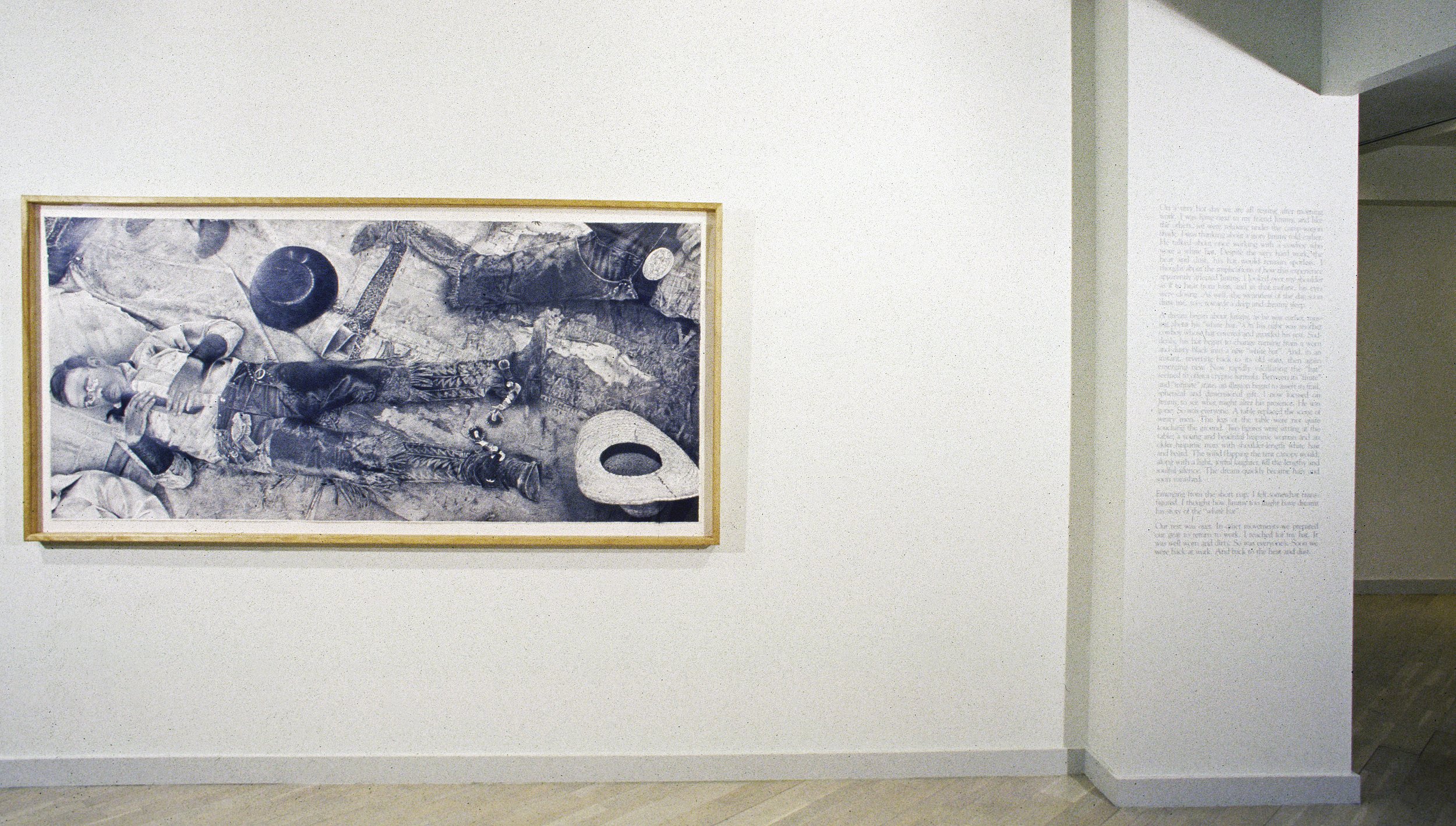
On a very hot day we are all resting after work. I was lying next to my friend Jimmy, and like the others, we were relaxing under the camp-wagon shade. I was thinking about a story Jimmy told earlier. He talked about once working with a cowboy who wore a white hat. Despite the hard work, the heat and dust, his hat would remain spotless.I thought about how this experience may have affected Jimmy. I looked over my shoulder as if to hear from him, and in that instant, his eyes were closing. As well, the weariness of the day soon drew me, too, towards a deep and dreamy sleep. A dream began about Jimmy, as he was earlier, musing about his "white hat." On his right was another cowboy whose hat covered and guarded his rest. Suddenly, his hat began to change, turning from a worn and dusty black, into a new "white hat." And, in an instant. reverting back to it's old state, then again, emerging new. Now rapidly vacillating, the "hat" seemed to offer a cryptic formula. Between it's "finite" and "infinite" state, an illusion began to assert it's frail, spherical and dimensional gift. I now focused on Jimmy to see what might alter his presence. He was gone. So was everyone. A table replaced the scene of weary men. The legs of the table were not quite touching the ground. Two figures were sitting at the table; a young beautiful hispanic woman and an older hispanic man with shoulder-length white hair and beard. The wind flapping the tent canopy would, along with a light, joyful laughter, fill the long and soulful silence. The dream quickly became hazy and soon vanished. Emerging from the short nap, I felt somewhat transfigured. I thought how Jimmy too might have dreamed his story of the "white hat." Our rest was over. In quiet movements we prepared our gear to return to work. I reached for my hat. It was well-worn and dirty. So was everyone's. Soon we were back at work, and back into the heat and dust.

The type of large-scale work Blagg is known for began at the Pennsylvania Fine Arts Academy in Philadelphia. He worked on a life-size portrait of a fellow student and found he really enjoyed that kind of presence. While working on another portrait project, he became good friends with John Schoonover, whose grandfather, Frank Schoonover, was a famous illustrator and a friend of N.C. Wyeth. Visiting Schoonover’s studio, he saw an extraordinary collection of wildlife, Native American artifacts, clothing, and relics, and he was permitted to borrow a taxidermied bald eagle from the turn of the nineteenth century. Blagg spent the next three months drawing the eagle in great detail and at life-size. “It was pretty intense. I remember I wanted to get every quill and every feather, so my pencils were like hypodermic needles. I would spend two or three weeks just sharpening and whittling pencils, and then I could do my drawing. I just enjoyed the sense of a larger scale.” Blagg was also influenced by the scale and composition of Rose Bonheur’s The Horse Fair, which he viewed on a trip to the Metropolitan Museum of Art in New York City. “When I saw this I was flabbergasted… and now the picture still breathes— it still knocks me flat. It’s a very deliberate, choreographed composition of horses and an amazing accomplishment.” However, on his first trip to the Waggoner Ranch near Vernon, Texas, Blagg’s approach to the scale of the outdoors truly developed. He went to the ranch to briefly visit his brother, Jim, who worked there as a cowboy. Blagg would end up returning to the ranch yearly and staying for up to three weeks at a time. The immensity of the landscape left a significant impression on the artist.
“It was a real connection with the land. The silence and all of the openness was very impressive. I would go back to the studio and start a four - or five-foot drawing, but that didn't work. I just kept adding pieces of paper on the end of what I'd been completing, and three weeks later, I had a rough sketch that was twenty-one feet long. I found that scale worked. It connected to the experience that I had. I really liked the way that looked”
Woodrow Blagg


